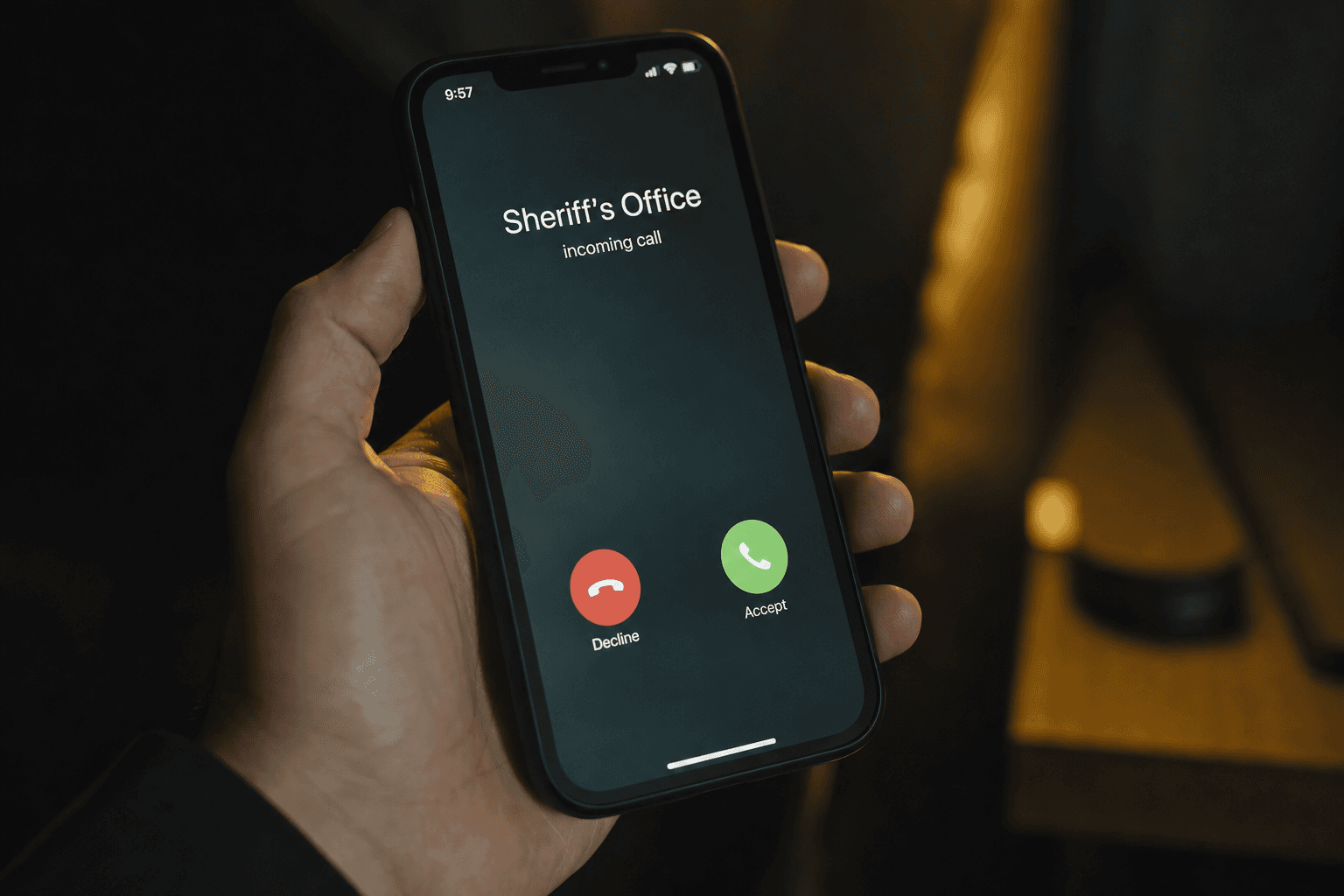
The Short Answer
If someone calls claiming to be a sheriff or deputy and says there is a warrant out for your arrest, that you missed jury duty or a court date, and that you must pay or be arrested today, it is almost certainly a scam. Real law enforcement does not call to warn you about a warrant and does not collect money over the phone. ScamVerify™ tracks this exact pattern: as of late June 2026, our FTC and FCC data holds 369,525 complaints about government-impersonation calls, with 64,164 in the last 90 days alone. You are not the first person this number has called, and you can hang up right now.
What the Call Sounds Like
The script is engineered to put you in fear before you can think. A calm, official-sounding caller gives a name and a badge number, then tells you one of a few stories:
- You missed jury duty, so a judge issued a failure-to-appear warrant.
- There is a warrant tied to a court case, often a child-services or "DSS" case, and you have a deadline to resolve it.
- A package or document with your name on it was flagged, and now there are federal charges.
Then comes the catch: you can avoid arrest by paying a "fine" or "bond" immediately, usually with a gift card, a wire, cryptocurrency, or a cash deposit at a kiosk. They will tell you to stay on the line and not speak to anyone. That instruction is the scam protecting itself.
Why Your Caller ID Showed the Real Sheriff's Number
Most people who fall for this say the same thing: "But the caller ID said it was the sheriff's office." Scammers use caller ID spoofing to make any number they want appear on your screen, including the real, published number of your local sheriff or court. The number on your phone is not proof of anything. In our data, government-impersonation calls cluster heavily in a handful of area codes right now, led by 315, 202, 502, 918, and 706, but a spoofed call can show any prefix, including your own.
The One Tell That Gives It Away Every Time
Strip away the badge numbers and the legal language and every version of this scam ends in the same place: a demand for an unusual payment, fast. No real sheriff, court, or agency collects fines by gift card, wire, crypto, or a Bitcoin ATM. The moment money comes up, you have your answer.
| Red flag | Why it signals a scam |
|---|---|
| Threatens immediate arrest if you do not pay | Courts resolve warrants in person, never by phone payment |
| Wants a gift card, wire, crypto, or cash kiosk deposit | No agency collects fines this way, because it is untraceable |
| Tells you to stay on the line and tell no one | Isolation stops you from verifying or asking for help |
| Caller ID shows the real sheriff or court number | Spoofing fakes any number; the display proves nothing |
| Knows your name, address, or family details | Bought or breached data, used to sound legitimate |
"But They Knew My Name and Address"
This is the part that keeps good, careful people on the line, so it deserves a straight answer. Scammers routinely have real personal details about you: your name, your address, where you work, sometimes a recent life event. None of it came from a court. It came from data breaches, public records, and data brokers who sell this information in bulk. A caller knowing your details is not evidence the call is real. It is just the modern starting point for the scam.
A Real Case We Handled
Earlier this year a new father came to Ava after a string of calls. A man identifying himself as a sheriff's deputy said he had missed a court date connected to a child-services case, that a warrant had been issued, and that he had until Wednesday to appear or settle it by phone. The caller knew real details about his family, including that his household had recently welcomed a baby, which made the threat feel terrifyingly specific.
He gave Ava the three numbers that had called him. She checked each one against the complaint and carrier data, confirmed the pattern as government impersonation, and was blunt about it: there was no warrant, there was no Wednesday appointment, and he should not go anywhere or pay anyone. She reported the numbers and walked him through exactly what to watch for next. The deadline came and went. Nothing happened, because there was nothing real behind it.
Got a call like this?
Tell Ava what happened. She checks it against millions of FTC and FCC complaints and real-time carrier data, then tells you exactly what you are dealing with.
What Real Law Enforcement Actually Does
- Warrants are served in person, not announced by phone. No deputy calls ahead to let you pay your way out of an arrest.
- Courts contact you by mail. A missed jury summons or court date generates a letter, not a threatening call.
- No agency takes gift cards, wires, or crypto. Fines and bonds go through a clerk of court, in person or through official channels, never a kiosk.
- You are always allowed to hang up and call back. A legitimate office will give you its main number and expect you to verify. A scammer will fight to keep you on the line.
What to Do in the Next 10 Minutes
- Hang up. You owe a caller nothing, and ending the call costs you nothing. Do not press any keys, do not "stay on the line."
- Do not pay or share anything. No payment, no Social Security number, no bank details, no codes read aloud from your phone.
- Verify independently if you are unsure. Look up your county sheriff or court on its official .gov site and call the published number yourself. Confirm there is no warrant and no appointment.
- Let Ava check it. Describe the call to Ava, or paste the number the caller used. She checks it against the same complaint and carrier data we track, tells you whether it is a known government-impersonation line, and walks you through your specific next step.
- Report it. File at ReportFraud.ftc.gov and tell the real agency that scammers are spoofing its number. Your report feeds the same data that warns the next person.
For the full breakdown of how this scam works, including the sheriff, jury-duty, Social Security, and IRS variants, see our guide to government impersonation scams.
What Happens If You Just Hang Up
Nothing. This is the question that keeps people on the line, so here is the plain answer: if you hang up on a fake warrant call, no deputy comes to your door and no warrant appears, because there was never a real case behind it. The caller may try again from a different number, since scammers cycle through them quickly, but the threat has no teeth. If you ever did have a genuine legal matter, a missed jury summons, or an unpaid fine, you would hear about it by mail from the court, with time to respond, never through a phone call demanding payment in the next hour. Hanging up is always the safe move.
I Already Paid or Gave Information. Now What?
You are not the problem here, and acting fast still helps. If you paid by gift card, call the card company immediately and report it as used in a scam; funds are sometimes recoverable if you move quickly. If you wired money or used a payment app, call your bank and ask them to attempt a reversal. If you shared your Social Security number or other personal details, place a free fraud alert with the credit bureaus and start a recovery plan at IdentityTheft.gov. Then describe exactly what happened to Ava, and she will tell you the specific next steps for your situation.