Key Finding
When ScamVerify™ first flagged the number 888-269-4978 in our April 8 newsletter, it had drawn 474 complaints in 12 days. We called it one of the fastest-rising scam numbers in our data and said it was worth watching.
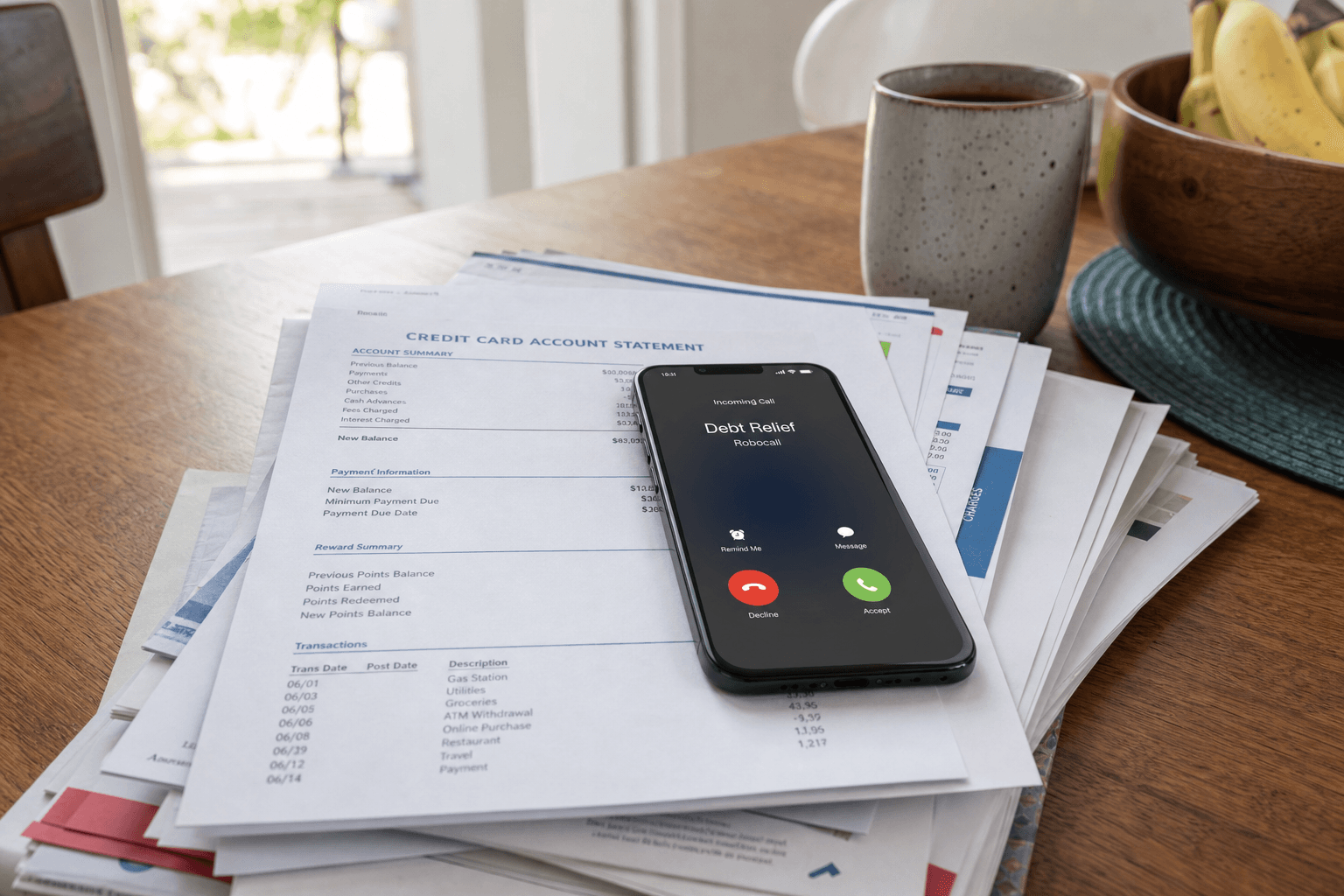
It was. As of May 21, 2026, that number has 1,850 FTC complaints, every one of them filed in the last 90 days, making it the single most-complained-about active scam number in our database. It runs at an 89 percent robocall rate, and the overwhelming majority of complaints, 1,223 of them, are tagged "Reducing your debt." This is a debt-relief robocall operation, and it has not slowed down.
This report breaks down 888-269-4978, the broader debt-robocall surge it belongs to, and the data behind it.
The Number, By the Numbers
| Metric | Value |
|---|---|
| Phone number | (888) 269-4978 |
| Total FTC complaints | 1,850 |
| Complaints in last 90 days | 1,850 (100%) |
| Robocall rate | 89% |
| Top complaint category | Reducing your debt (1,223) |
| Most recent complaint | May 21, 2026 |
| When we first flagged it (April 8) | 474 complaints |
A number that quadrupled its complaint count in roughly six weeks, while keeping a near-90-percent robocall rate, is not a misdialing business. It is an automated operation running at industrial volume.
Why Debt-Relief Robocalls Dominate
888-269-4978 is not an outlier. It sits at the top of the largest scam-call category in our data. Debt relief, logged by the FTC as "Reducing your debt (credit cards, mortgage, student loans)," is consistently one of the highest-volume complaint subjects across our 14.8 million FTC complaint records, and it is overwhelmingly robocall-driven.
The pitch is always some version of the same promise: a robocall claims it can slash your credit-card interest, settle your debt for pennies on the dollar, or "forgive" your student loans, then routes you to a live closer who collects an upfront fee, your bank details, or both. The Federal Trade Commission has been explicit that legitimate debt-relief services do not cold-call you with robocalls, and charging fees before settling any debt is illegal.
The Debt-Robocall Rings Behind the Surge
The reason these numbers are so hard to block is that they do not operate alone. They run in blocks of sequential toll-free numbers, so when one gets reported and blocked, the operation rotates to the next. In our current data, several of these prefix clusters are highly active in the last 90 days:
| Toll-free prefix | Numbers in block | Complaints (last 90 days) | Avg robocall rate |
|---|---|---|---|
| 855-909-0xxx | 24 | 3,950 | 87% |
| 866-959-1xxx | 19 | 2,770 | 90% |
| 833-588-3xxx | 20 | 2,710 | 86% |
| 855-357-2xxx | 14 | 2,611 | 91% |
The 855-909 block is worth noting on its own. ScamVerify exposed a 855-909 debt operation earlier this year when it spanned 11 numbers and roughly 3,100 complaints. It has since grown to 24 numbers and more than 5,400 total complaints, with 3,950 of them in just the last 90 days. The operation did not get shut down. It scaled.
How These Operations Stay Alive
- Number rotation. Sequential toll-free blocks let the operation abandon burned numbers and shift volume to fresh ones without missing a beat.
- Toll-free cover. Toll-free prefixes (888, 866, 855, 833) look like legitimate customer-service lines, which lowers a target's guard compared to an unknown mobile number.
- Automation. At an 85 to 90 percent robocall rate, these are dialers blasting recordings to massive lists, transferring only the people who press a key to a human.
- A real financial pain point. Debt is a genuine stressor for millions of people, so the pitch lands on receptive ears in a way a fake lottery never could.
Methodology
The figures in this report come from ScamVerify's production database of more than 14.8 million Federal Trade Commission complaint records and 359,000 FCC complaint summaries, covering roughly 7.1 million unique phone numbers. Complaint counts, robocall percentages, and category tags reflect FTC-reported data as of May 21, 2026, with the standard one-to-two-day reporting lag. "Last 90 days" reflects complaints with a report date inside the trailing 90-day window. Prefix-cluster figures group numbers sharing the same seven-digit toll-free prefix and active in the last 90 days.
How to Protect Yourself
Check a number before you trust it. Run any unfamiliar toll-free or unknown number through the ScamVerify phone lookup. If it is already tied to debt-relief robocall complaints, you will see it.
Do not press any key. Pressing a number to "speak to a representative" or "be removed from the list" confirms your line is live and routes you straight to a closer. Hang up instead.
Never pay an upfront fee. Legitimate debt-relief services do not charge before settling debt, and they do not reach you through robocalls. An upfront-fee demand is the scam revealing itself.
Report it. File robocall complaints with the FTC at ReportFraud.ftc.gov and DoNotCall.gov. This data feeds the same records this report is built on and helps flag the next number in the rotation.
The Bottom Line
888-269-4978 is a case study in why scam robocalls are so persistent. We flagged it at 474 complaints, and rather than fade, it nearly quadrupled to 1,850 while running almost entirely on automation. It is the loudest voice in the single largest scam-call category in our data, backed by rotating blocks of toll-free numbers that scale faster than they get shut down. Treat any unsolicited debt-relief robocall as a scam, never press a key, and check unknown numbers before you engage.
FAQ
Is 888-269-4978 a scam number?
Based on ScamVerify's FTC complaint data, 888-269-4978 has drawn 1,850 complaints, all within the last 90 days as of May 21, 2026, with an 89 percent robocall rate and the majority tagged as debt-relief calls. It is the most-complained-about active number in our database. Treat any call from it as an illegal debt-relief robocall, do not press any keys, and hang up.
Why do I keep getting debt-relief robocalls from different toll-free numbers?
Because these operations run in blocks of sequential toll-free numbers and rotate through them. When one number gets reported and blocked, the dialer shifts to the next in the block, which is why you may hear nearly identical pitches from 855, 866, 833, and 888 numbers. Several of these prefix clusters logged thousands of complaints in just the last 90 days.
Are debt-relief robocalls ever legitimate?
No. Legitimate debt-relief and credit-counseling services do not reach out through unsolicited robocalls, and federal rules make it illegal to charge fees before actually settling a debt. Any robocall promising to slash your interest, settle your debt for a fraction, or forgive loans, then asking for an upfront payment or your bank details, is a scam.
How does ScamVerify know a number is a scam?
ScamVerify draws on a production database of more than 14.8 million FTC complaint records and 359,000 FCC complaint summaries, covering about 7.1 million unique phone numbers, alongside carrier and threat-intelligence data. When you look up a number, it shows complaint volume, recent activity, robocall rate, and the categories people reported, so you can see exactly why a number is flagged.